A composite geotextile for fish ponds, small reservoirs and dams where a flexible seepage barrier and protection layer are needed in one roll.
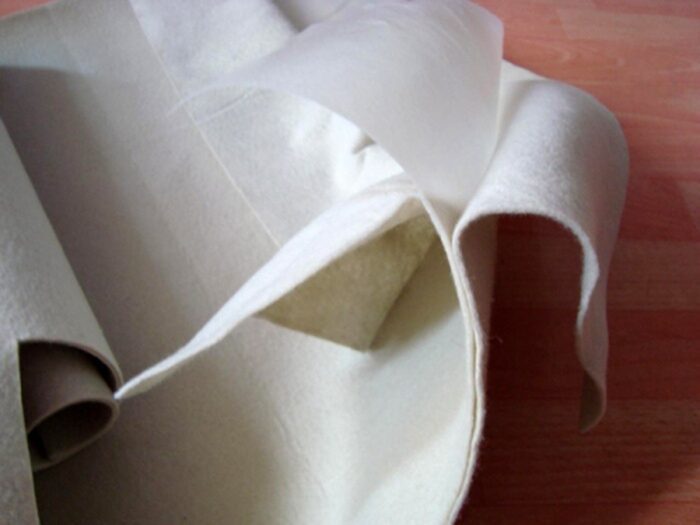
Representative photo of Anti-Seepage Composite Geotextile; final surface, width and roll length are confirmed at order.
| Structure | 2F1M or 1F1M |
| Common build-ups | 500g/1.0mm/500g; 600g/1.5mm/600g |
| Width | 4-6 m |
| Permeability | ≤ 1×10⁻¹³ cm/s |
| Standard | GB/T 17642-2008 |
Typical production ranges for Anti-Seepage Composite Geotextile; project values are confirmed against the drawing and test report before shipment.
Request data sheet & quoteFish ponds, reservoirs and small dams needing a flexible seepage barrier. The material package around Anti-Seepage Composite Geotextile — cushion geotextile, drainage, anchoring and welding — is selected with the same drawing.
It is a lighter composite for low-head water storage. For a municipal landfill or high-head reservoir, use a specified HDPE or 2F1M composite with the required test values.
Compare with my specificationYellow River Delta aquaculture pond renovation — 1.0 mm HDPE liner, 8 m width, 12 ponds. Reference configuration for Anti-Seepage Composite Geotextile, not a delivered project record.
Reference configurations, not delivered project records.
A composite geotextile for fish ponds, small reservoirs and dams where a flexible seepage barrier and protection layer are needed in one roll.
Final thickness, width and surface are confirmed against the drawing, design head and chemical exposure.
Welding parameters and seam records for Anti-Seepage Composite Geotextile are supplied with the shipment; for the first production welds, an engineer can attend site.
It can be used for low-head storage, but large reservoirs usually require a designed HDPE or composite liner with project-specific thickness, anchoring and testing. Confirm with the design.
Composite membrane protects the liner during installation and service, and adds filtration. It is widely used for canals, reservoirs and ponds where site conditions are less controlled.
It describes 600 g/m² geotextile on each face of a 1.5 mm geomembrane. Heavier fabric gives more puncture protection and tensile strength.
The membrane edge is exposed for double-track thermal welding; fabric edges are stitched or overlapped according to the installation method statement.
Other products in the composite range, plus the eight material systems used around Anti-Seepage Composite Geotextile.
Composite Geomembranecanals, reservoirs and ponds where lining and filtration are combined
Composite Geomembranereservoir and canal lining with 600g/1.5mm/600g typical build-up
Composite Geomembranechannel lining and ponds where a lighter composite is specified
Composite Geomembranebasement and roof waterproofing with a bonded membrane core
Fill what you know. The button creates a structured email in your mail app; nothing is stored on this website.
Send the specification values, area, head and delivery port for Anti-Seepage Composite Geotextile; we will confirm the standard and reply with a material schedule.